#Product Trends
Steel Pergola vs Aluminum Pergola: Which Should You Choose?
Compare steel and aluminum pergolas by strength, coating, snow load, freight cost and certification. A sourcing guide for pergola dealers and importers.
A steel pergola is an outdoor shade structure built from galvanized or zinc-aluminum-magnesium coated steel profiles, engineered for high load capacity and structural rigidity. An aluminum pergola is a shade structure built from extruded aluminum alloy profiles, valued for corrosion resistance, lighter weight, and faster installation. Both formats dominate the motorized and manual louvered pergola market, and both are produced at scale for export by manufacturers in China. The right choice depends on the target market climate, the buyer’s positioning, and the balance between structural performance and handling cost.
In practice the decision narrows on three variables: the climate the structure ships into, the span it has to cover, and what a service call costs in that territory. None of the three appears on a specification sheet, which is why two product lines with identical published figures can produce very different warranty exposure over five years.
What Is a Steel Pergola?
A steel pergola uses cold-rolled steel profiles, typically 100x100mm posts, formed into a freestanding or wall-mounted frame that carries a louvered or fixed roof. Steel’s defining advantage is strength. The material’s higher tensile strength allows a steel frame to carry heavier roof loads with the same profile dimensions, which translates directly into higher snow load ratings and better resistance to wind uplift. Perceived movement in wind is usually an anchoring and column-spacing question rather than a profile-strength one, and steel’s rigidity gives it an advantage on wide spans where aluminum would need extra columns to feel equally solid.
Wind figures repay a second look, because most suppliers publish a test result and leave the warranty position unstated. alux warrants its structures to Beaufort 9 and validates that commitment in a simulation environment running at Beaufort 10, so the warranted figure sits a full grade inside what the structure has been shown to withstand rather than at the edge of it. A rating backed by testing one grade above the guarantee behaves differently in a storm from one quoted at the limit of what was measured.
The historical weakness of steel outdoors is corrosion, and modern coating systems have changed that calculation. Current export-grade steel pergolas use ZAM coated steel, a zinc-aluminum-magnesium alloy layer applied to the base steel at 150 to 170 g/m², followed by chemical passivation and a powder coat finish of around 80 microns. Structures built with this system pass 168 hour salt spray testing and are rated for five years or more of rust resistance in normal outdoor exposure.
Where steel structures fail in the field, the failure almost never starts on a flat face. It starts at cut edges, drilled holes and welded joints, which is why the sequence of fabrication matters as much as the coating specification. Where the ZAM layer goes on before profiles are formed, as it does on alux steel, the coating carries through cutting and drilling rather than sitting on top of a structure that has already been machined. Rust streaking down a column in the second or third winter is one of the most common warranty contacts in this category, and it traces back to that sequence rather than to the metal itself.
Typical steel pergola specifications in the current export market:
Snow load rating: 50 to 60 kg/m² depending on louver profile
Louver rotation: 0 to 120 degrees, manual crank standard, motorized optional
Common footprint sizes: 3x3m, 3x4m, and 3x6m at 2.2 to 2.4m height
Options: zip screens, LED lighting, flat-pack KD versions for container efficiency
What Is an Aluminum Pergola?
An aluminum pergola uses extruded aluminum alloy profiles, most commonly 6063-T5, assembled into the same structural formats as steel: freestanding four-post frames, wall-mounted lean-to units, and larger multi-bay configurations. Aluminum’s defining advantages are natural corrosion resistance and weight. The material forms a protective oxide layer on its own, so even scratches that penetrate the powder coat do not lead to rust.
Aluminum pergola extruded profile cross-section and louvered roof detail showing wall thickness and internal ribs
Weight is the second structural difference. Aluminum is roughly one third the density of steel, which affects every stage of the supply chain: lighter crates, lower per-unit freight cost, easier two-person handling on site, and installation times of around two hours for a standard 3x4m unit. Premium aluminum pergolas in the current market reach snow load ratings of 50 to 120 kg/m² depending on profile design, with louver rotation of 0 to 120 degrees and motorized operation as the standard configuration in mid-range and luxury lines.
Two production details sit underneath that specification and decide whether the roof still seals in year five. The first is blade sizing: a blade dimensioned for a 3 metre bay deflects visibly at 5 metres, so alux matches blade depth to rated span rather than offering one universal profile, and treats the blade-to-rail fit as a control point during assembly rather than an item checked at final inspection. Tolerance drift at that interface is what produces the complaint dealers hear most in wet climates, where a roof that no longer closes flush lets water onto the furniture below.
The second is drive selection. Where motors are specified by function rather than fitted one type everywhere, as on the alux range, louver rotation runs on Hongze linear actuators rated 24 V DC and IP67 at 600 N thrust and 4 mm per second, while retractable screens run on Dooya tubular motors. The two duties are not interchangeable, since a louver actuator works in short high-force strokes against blade weight and wind load while a screen motor runs long continuous travel under light tension, and fitting one type to both jobs is the usual reason a drive fails inside the warranty period. Both are named brands with independent parts channels. An unbranded assembly cannot be re-sourced once the original supplier changes model, which is how a five year old roof ends up unrepairable. Named drives on motorized pergola systems stay orderable through the motor manufacturer itself, independently of who built the frame.
Key Differences: Steel Pergola vs Aluminum Pergola
The comparison below summarises the two materials across the criteria that matter most in commercial sourcing decisions:
Criteria Steel Pergola Aluminum Pergola
Material strength Higher tensile strength per profile size Lower, compensated by profile design
Weight Heavy, more anchoring stability About one third of steel, easier handling
Corrosion resistance Depends on coating (ZAM plus powder coat) Inherent, oxide layer self-protects
Snow load range 50 to 60 kg/m² typical 50 to 120 kg/m² depending on series
Louver rotation 0 to 120 degrees 0 to 120 degrees
Coastal suitability Good with intact ZAM coating Excellent, preferred for marine climates
Unit price position Lower, entry to mid market Mid to luxury market
Freight cost Higher per unit weight Lower, favourable container economics
Installation Heavier lifts, longer assembly Around 2 hours for standard sizes
Repairability Coating damage needs touch-up to prevent rust Scratches remain cosmetic
Typical warranty 5 years 5 to 10 years by series
Durability and Climate Suitability
Material choice interacts directly with the destination market’s climate, and climate decides this question more often than price does. A material that performs well inland can be the wrong specification two hundred metres from the sea, and the difference surfaces in year three rather than on delivery.
Cold and snow-heavy markets
Both materials serve snow markets when correctly specified. Steel offers strong load capacity at a lower price point, which suits entry-level and mid-market positioning in Northern Europe and North America. High-specification aluminum series with reinforced louver profiles reach 120 kg/m² ratings and serve the premium end of the same markets. The critical check for buyers is the tested snow load figure for the specific model, not the material category alone. Across the alux range that means 50 to 60 kg/m² on steel and 50 to 120 kg/m² on aluminum, with TÜV witnessing the on-site test at 50 kg/m² or above rather than the figure being derived on paper.
Coastal and high-humidity markets
Aluminum holds a clear advantage in marine and tropical environments. Salt air attacks any breach in a steel structure’s coating, while aluminum’s self-forming oxide layer keeps corrosion cosmetic rather than structural. For Middle East coastal projects, Southeast Asian resorts, and Australian coastal retail, aluminum is the standard recommendation. ZAM coated steel performs well in these environments too, provided the coating stays intact through fabrication and installation. Applying the ZAM layer at 150 to 170 g/m² before forming, as alux does, keeps coastal steel viable where budget rules aluminum out.
Hot arid markets
Both materials perform well in dry heat. Powder coat UV stability matters more than the substrate here, and buyers should confirm that coatings are rated for high-UV exposure, particularly for dark colours that reach high surface temperatures. Uneven fading or chalking on the sun-facing side, usually appearing within two seasons, is a film thickness and UV grade problem rather than a substrate one, which is why it shows up on cheap aluminum as readily as on cheap steel. Film thickness is the control that decides it, held at approximately 80 microns over chemical passivation on alux profiles, with 100 hour UV exposure results behind the figure. Guidance on powder coating durability classes is published under Qualicoat specifications, a common reference standard in architectural aluminum finishing.
Why Surface Treatment Matters More Than Material Category
ZAM coated steel pergola profile layers showing zinc aluminum magnesium coating and powder coat finish
Every pergola manufacturer serving the export market offers both steel and aluminum, so the material category is not a differentiator. What varies between suppliers is the surface treatment stack and how consistently it is applied, and that variation predicts field performance far better than the metal on the specification sheet.
The asymmetry is worth understanding. Aluminum tolerates process failure gracefully, because a scratch through the powder coat exposes metal that forms its own oxide layer and the damage stays cosmetic. The same scratch on steel starts a corrosion path. This is why two aluminum pergolas at similar prices rarely diverge in the field while two steel pergolas often do, and why coating specification deserves more scrutiny on steel than the strength figures that usually dominate the conversation.
The consequence is measurable rather than theoretical. Coating claims are the largest single category of steel pergola service calls, and they surface in years two to four, after the margin has been recognised and the cost has moved downstream. A documented and tested coating stack removes a cost the reseller would otherwise absorb quietly, which is why it is worth comparing across a supplier’s full range rather than on the premium series alone. The same specification runs through steel pergola systems and aluminum louvered pergola systems where a manufacturer treats it as a process rather than a selling point.
Cost, Logistics and Margin Structure
The landed cost picture differs from the factory price comparison, and the gap widens once installation and post-handover service enter the calculation.
Steel pergolas carry a lower factory price for equivalent footprint and features, which supports competitive retail pricing in the entry and mid segments. The offset is freight: steel units weigh substantially more, and sea freight for oversized outdoor structures is charged in ways that penalise weight and volume together. Flat-pack KD versions reduce container space significantly and are the standard format for dealers importing at volume. Where a factory runs both formats in parallel, as the 46,000 m² alux production facility does at 4,500 sets a month, mixed-format consolidation on a single order becomes possible.
Aluminum pergolas carry a higher factory price but a lighter logistics footprint. More units fit into a container at lower total weight, per-unit freight drops, and destination handling costs fall. In markets where installation labour is expensive, the shorter assembly time of aluminum also feeds margin: an installation crew completing a unit in two hours instead of a half day changes the dealer’s cost per installed sale.
Landed cost and installation time are the visible half of the margin picture. The invisible half is service cost after handover. A single warranty visit consumes a technician day, transport, and often a part shipped from origin, and it lands on the dealer regardless of who manufactured the fault. Two such visits erase the margin on the unit. This changes how the price gap should be read: a steel unit that costs less at the factory but generates one extra service visit per twenty installations is not cheaper where labour is expensive, while in dry, low-labour, price-driven territories the steel advantage holds and the exposure stays low.
The margin logic therefore differs by segment rather than by preference. Steel anchors volume-driven programs where retail price competitiveness wins the sale. Aluminum carries premium positioning where motorized operation, integrated LED lighting, zip screens, and longer warranties justify the higher ticket. Dealers who stock only one are answering every enquiry from a single price point, which loses budget-driven quotes at one end and specification-driven commercial projects at the other. The obvious response is to carry both, and the question then becomes whether to run two supplier relationships or one. Two means two sets of assembly instructions, two parts inventories, two colour standards that will not match across a shared showroom, and two certification packs to reconcile at customs. Sourcing both lines from a single manufacturer removes all of that, which is the practical argument for working with a factory that extrudes aluminum and forms ZAM steel on the same site under one quality system. Comparatively few do, since most specialise in one material and buy the other in.
What to Verify Before Ordering
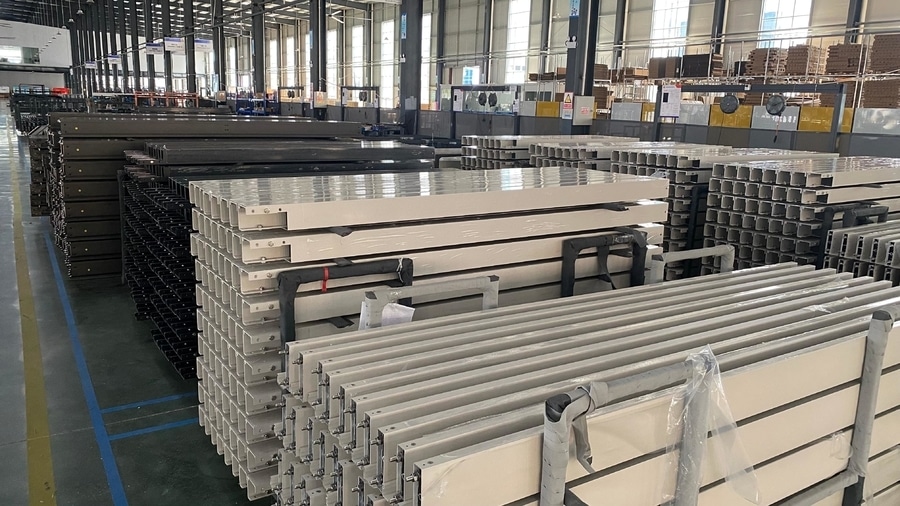
Pergola manufacturing facility with metal profiles and louvered roof components on the production line
Regardless of material, the verification list is much the same. Each point below corresponds to a failure mode that surfaces after installation rather than at goods-in inspection, which is why they are worth settling before a first container:
Coating weight and fabrication sequence. Ask for coating weight in g/m² rather than the word galvanised, and ask whether cutting and drilling happen before or after coating. Edge corrosion tracks this more closely than any other variable.
Salt spray hours with the testing body named. 168 hour results are the current benchmark for coated steel outdoor structures, and the report should arrive alongside the coating weight rather than in place of it.
Film thickness and UV hours, fixed contractually. A 40 micron coat and an 80 micron coat are indistinguishable on delivery and completely different by year three, which makes this the specification most often thinned to hit a target price.
Blade depth and wall thickness at each span. Ask whether the closed roof is water-tested before packing, and whether blade profile varies with span.
Drive brand, ingress rating and parts path. Ask which motor brand is fitted, whether louvers and screens use separately selected units, and who supplies replacements in year five. A drive named on the specification sheet remains orderable through the motor manufacturer independently of the pergola supplier.
Load ratings: tested or calculated, and by whom. Ask where the warranty boundary sits relative to the tested figure, since the two are rarely the same number.
Certification for the destination market. CE marking for the EU covering EMC and LVD for motorized units, UKCA for the UK, and third-party test reports from bodies such as TÜV Rheinland add verification weight. Full certification documentation is worth requesting before the first order rather than after a customs query.
Packaging format. Flat-pack KD versus pre-assembled affects container loading, damage rates, and installation time at destination. Ask whether both formats can ship on one order.
Factory audit status. ISO 45001 and amfori BSCI audits indicate management system maturity beyond product-level testing, and a documented production facility is worth reviewing before a first order.
Buyers developing their own branded outdoor living lines can extend this checklist into custom development. Manufacturers offering full custom production programs support custom colours, branded packaging, modified dimensions, and market-specific certification packages, which is the standard route for established dealers converting import volume into brand equity.
Frequently Asked Questions
Q: Which is better, a steel pergola or an aluminum pergola?
Neither material is universally better. Steel offers higher strength per dollar and suits entry to mid-market positioning, particularly in snow markets where load capacity at a competitive price wins sales. Aluminum offers inherent corrosion resistance, lighter logistics, faster installation, and suits premium positioning and coastal climates. The right choice follows the destination market’s climate and the buyer’s price segment.
Q: Do steel pergolas rust?
Modern export-grade steel pergolas use zinc-aluminum-magnesium (ZAM) coated steel with a powder coat finish, a system that passes 168 hour salt spray testing and carries rust resistance ratings of five years or more in normal outdoor exposure. Rust becomes a risk where the coating is breached at cut edges, drill holes or welds and left untreated, which is why coating weight and the point at which fabrication happens matter more than the word steel itself.
Q: Are aluminum pergolas strong enough for snow?
Yes, when correctly specified. Aluminum pergola series in the current market carry tested snow load ratings from 50 kg/m² for standard profiles up to 120 kg/m² for reinforced premium series. Buyers serving snow-heavy regions should verify the tested rating of the specific model rather than assuming any material-level rule, since profile design determines load capacity more than the substrate alone.
Q: Why are aluminum pergolas more expensive than steel?
Aluminum alloy costs more than steel as a raw material, and extrusion tooling adds fixed cost per profile design. Part of the difference returns through the supply chain: aluminum’s lower weight cuts freight and handling costs, and faster installation reduces labour cost at destination. Comparing landed and installed cost rather than factory price gives a more accurate picture of the real difference.
Q: Which material generates fewer warranty claims for a dealer?
Aluminum generates fewer coating-related claims, because corrosion on aluminum stays cosmetic rather than structural even where the powder coat is breached. Steel claims cluster around handling damage that was not touched up at installation. Mechanism and motor claims occur on both materials and correlate with drive specification rather than substrate, so dealers tracking claim rates should separate coating claims from mechanism claims. Motor claims are also the most expensive to resolve, which is why the drive brand and its parts availability deserve as much attention at sourcing as the frame material.
Q: Should a dealer stock one material or both?
Both, in most territories. A single material limits a dealer to one price segment, which loses budget-driven quotes at one end and specification-driven quotes at the other. Carrying both from one manufacturer avoids the operational cost of a second supplier relationship while covering the full range of incoming enquiries. Dealers in strongly coastal territories are the main exception, since aluminum covers nearly all demand there.
Q: What certifications should a pergola manufacturer have for the EU market?
Motorized pergolas sold in the EU require CE marking covering the EMC and Low Voltage Directives for the electrical and motor systems. UKCA marking covers the same ground for the UK. Beyond mandatory marking, third-party test reports from laboratories such as TÜV Rheinland, plus factory-level audits such as ISO 45001 and amfori BSCI, indicate that both the product and the production system have been independently verified.
Q: What is the typical MOQ for custom pergola production?
MOQ structures vary by customisation depth. Stock models with custom packaging typically start at container-level quantities, around 10 to 20 units depending on size and packing format. Custom colours on existing profiles usually carry modest surcharges at similar volumes. Modified dimensions or new profile development involve tooling considerations and higher minimums, which manufacturers quote per project.
Conclusion
The steel versus aluminum question does not resolve at the material level, because both materials are engineered to the same performance envelope in the current export market. It resolves one level down, at the surface treatment, tolerance control and drive specification that sit underneath both, and one level out, at the market being served. Steel answers the wide-span, price-competitive, dry-climate case. Aluminum answers the coastal, premium, labour-expensive case.
Most dealer territories contain both, which is why the sourcing decision is usually about finding a manufacturer that produces both to a consistent standard rather than about picking a side. Steel delivers structural strength at a price point that wins in volume-driven segments, with modern ZAM coating systems resolving the corrosion concerns that once limited it. Aluminum delivers corrosion immunity, logistics efficiency and installation speed that fit premium programs and coastal markets.
Running both lines under one brand is exactly the structure alux is built around. ZAM coated steel and extruded aluminum louvered pergolas come off the same 46,000 m² site under one quality system, sharing colour standards, packaging, assembly documentation and a single certification package covering CE, UKCA, TÜV Rheinland test reports, ISO 45001 and amfori BSCI. A dealer catalogue built this way reads as one brand across both price segments rather than as two rebadged imports, and the parts inventory behind it stays single. Request a Quote to compare specifications for your market.