#Product Trends
Lower-carbon concrete public toilets for more sustainable cities
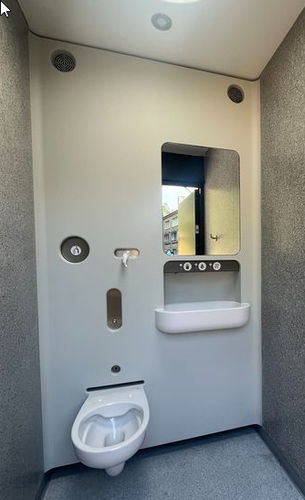
Francioli by CITYGIE Group combines durable public sanitation facilities with lower-carbon cement to help reduce the environmental impact of urban infrastructure.
Durability at the heart of public infrastructure
Public toilets must withstand intensive use, weather exposure, frequent cleaning and vandalism risks. Robustness, reliability and long-term durability are therefore essential considerations for cities.
Concrete meets these demanding requirements. Reducing its carbon footprint offers an opportunity to improve the environmental performance of everyday urban infrastructure.
Reducing emissions through material choices
Concrete accounts for more than 95% of the mass of our public sanitation facilities. To reduce their environmental impact, CITYGIE Group has focused on cement, a major contributor to concrete’s carbon footprint.
In 2020, we introduced CEM III cement into our production. Since the beginning of 2026, we have taken a further step by moving exclusively to CEM VI cement, adapting our manufacturing processes to support this transition.
CEM VI contains a lower proportion of clinker, the most carbon-intensive component of cement, with part replaced by blast-furnace slag and limestone.
Nearly 40% lower emissions for cement manufacturing
According to CITYGIE Group’s figures, the cement used generates 451 kg of CO₂ per tonne, compared with 752 kg for the reference CEM I cement — a reduction of approximately 40%.*
Our objective is to reduce environmental impact while maintaining the robustness, durability and reliability that cities expect from public sanitation facilities.
A long-term approach for European cities
Choosing a public toilet means investing in infrastructure intended to serve communities for many years. Beyond functionality and design, material selection and manufacturing processes deserve careful consideration.
At Francioli and CITYGIE Group, we continuously improve our products to combine lasting performance with a lower environmental impact.
Decarbonization also involves the everyday facilities that shape public spaces. Lower-carbon cement is one practical step towards more sustainable urban infrastructure.
*The comparison concerns emissions associated with cement manufacturing. It does not represent a 40% reduction in the carbon footprint of the complete public toilet.