#Product Trends
What is the difference between a convector and a radiator?
convector vs radiator
We often take a comfortable indoor climate for granted. Yet we rarely stop to consider the technology behind it. The way heat is emitted has a significant impact on our comfort. Convectors and radiators are the two most common heat emission systems. While radiators have earned their place in traditional heating systems, convectors are increasingly becoming the logical choice for modern, sustainable heating concepts.
How does a radiator work?
We rarely stop to think about how a radiator actually works. It simply hangs there, without us giving much thought to the way it operates. A radiator emits most of its heat through radiation. First, the heated water transfers its temperature to the metal mass of the radiator. Only once this mass has warmed up sufficiently does the radiator begin to effectively release heat into the room.
Traditional radiators deliver their highest output at higher water temperatures. At lower temperatures, they often need to be larger to provide the same level of comfort. It is a slower process that perfectly suited the world of the past, when gas and electricity were inexpensive and environmental considerations played a much smaller role.
In that world, the radiator performed exceptionally well. The system was robust and perfectly matched to the technology of the time. But times change, and so does the way we generate and distribute heat. Today, we aim to use energy more intelligently. Heat pumps, solar energy and well-insulated homes require a different type of heat emission: more efficient, faster to respond and with as little energy loss as possible.
How does a convector work?
Whereas a traditional radiator is heavy and often visibly present, this does not have to be the case with a convector. A convector can be discreetly concealed behind a subtle grille or in a slim designer casing, mounted against the wall or ceiling, or even seamlessly integrated into the wall, ceiling or floor.
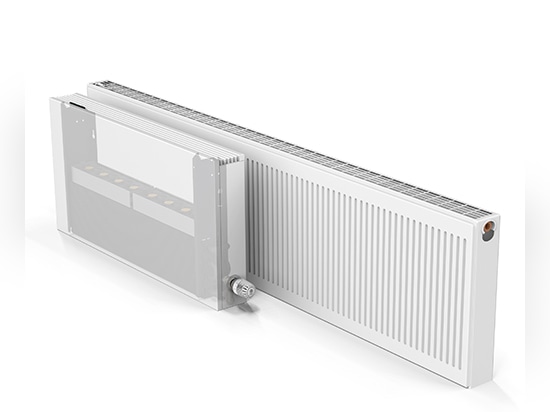
A convector works on the basis of airflow, or convection. Unlike a radiator, which first needs to heat up its entire mass, a convector uses lightweight, fast-responding components: thin copper tubes with fine metal fins. As soon as the water reaches the required temperature, the chimney effect comes into play: cold air is gently drawn in, heats up extremely quickly and then rises as a column of warm air. It is a discreet process that heats the room evenly without drawing attention to itself, unless the design is deliberately intended to be seen.
A convector is therefore not merely an alternative to the radiator, but a clear evolution. It fits perfectly into an era in which heating is no longer about brute force, but about precision, speed and efficiency.
Radiator vs convector
Convectors and radiators heat a room in different ways. While a radiator relies on radiant heat and a large mass that warms up gradually, a convector uses air circulation to distribute comfort quickly and efficiently.
Thanks to its lightweight construction and fast response time, a convector creates a feeling of warmth almost immediately and performs exceptionally well at low water temperatures. This makes it particularly suitable for modern heating systems, such as heat pumps, and for well-insulated homes. In addition, it is compact and lightweight, making it an ideal fit for contemporary interior design.
A traditional radiator, by contrast, is more visually prominent, heavier and less efficient at low water temperatures. It is best suited to older heating systems that operate with higher supply temperatures.
In short: anyone looking for a future-proof, energy-efficient and fast-responding heating system will quickly find that a convector is the natural choice.
Would you also like to cool?
Today, systems are also available that allow radiators to provide cooling. Although this is technically possible, these solutions are often less efficient than a convector equipped with a Jaga DBH set (Dynamic Boost Hybrid).
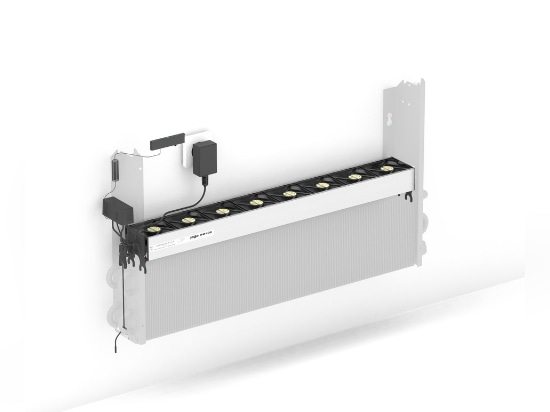
Certain Jaga convectors can be equipped with Dynamic Boost Hybrid technology. This allows them not only to heat more quickly and efficiently, but also to provide energy-efficient, non-condensing cooling when supported by the installation.
Anyone choosing a future-proof solution today looks beyond traditional heating alone. With Jaga convectors, you benefit from fast, energy-efficient heat emission, optimal performance at low water temperatures and the option to provide cooling as well. In this way, a convector becomes more than just an alternative to a radiator: it becomes a complete indoor climate solution for modern homes and buildings.