#Product Trends
Art Deco lighting fixtures from the 1930s
Metal structures with geometric shapes
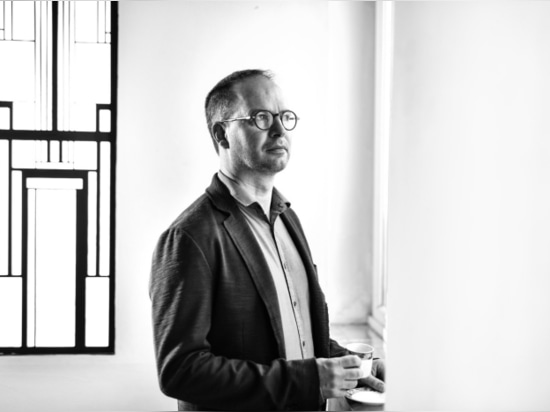
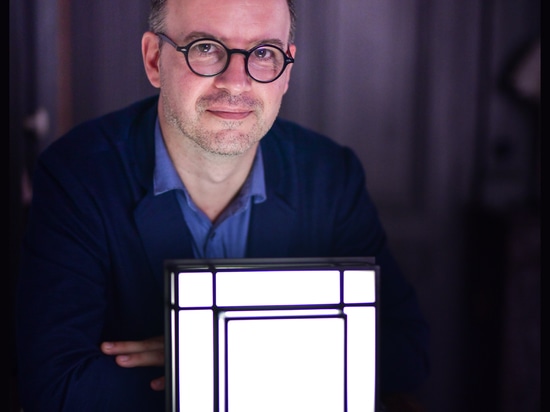
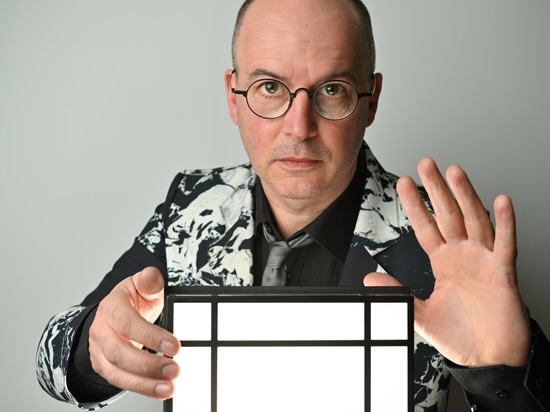
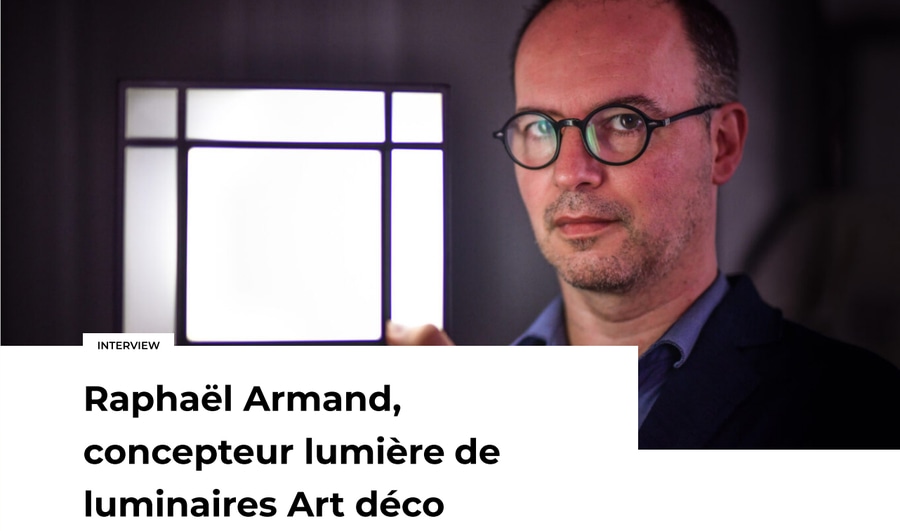
Raphaël Armand, designer of Art Deco-style lighting fixtures.
An unconventional lighting designer, Raphaël Armand seeks to restore the connection between light and architectural geometry, in the spirit of the 1930s.
Based in Lyon, Raphaël Armand recreates lighting for historic buildings and designs Art Deco-inspired fixtures. He revives the spirit of the interwar avant-garde while adapting it to 21st-century standards.
What is your background?
Raphaël Armand: I don’t have any formal training specifically in lighting. My grandmother was the manager of the Eldorado—a very large cinema in Lyon that was later converted into a theater, before being demolished in 1993. I spent my childhood in the world of performing arts, where I learned to understand light and shadow and how to handle stage lights. I later worked as a stage technician for live performances, dealing with both lighting and set design.
For a few years, I also ran an antiques shop, where I specialized in early 20th-century light fixtures with geometric structures. These various experiences gradually led me to my current profession.
What is your work today?
Raphaël Armand: For about fifteen years, I have been commissioned by historic buildings to work on lighting fixtures—not just as objects, but primarily as sources of light diffusion. I begin by studying archives and researching the history of the building and its architect—or, in the case of certain interwar-period structures, the lighting designers involved in the project. I gather as much information as possible to ensure the lighting is coherent, aligning my proposals with the architect’s original intentions or, where those are unknown, with what the building’s own geometry suggests.
How would you define your work?
Raphaël Armand: I am a lighting designer. For instance, I am currently working on two projects. I am designing the interior lighting for a church in Paris. I am using off-the-shelf light fixtures for direct illumination, while also creating indirect lighting through the use of apertures and specialized optics designed to bring out the architecture. I am also incorporating dimming controls via a DALI system.
The second project involves the Château Laurens in Agde. It features 145 light bulbs suspended from wires, each housed within a blown-glass shade. I need to develop a custom solution—something not available on the market—to recreate this lighting effect.
You also design your own light fixtures…
Raphaël Armand: Yes, because indirect lighting isn’t enough on its own. Humans need a luminous object—something that helps structure a space and draws the eye. In certain buildings, the challenge lies in ensuring that a light fixture doesn’t overshadow other objects listed in the inventory. Personally, I find empty spaces and white walls dreadful; we need objects to help us think.
When designing a light fixture, I draw inspiration from the highly geometric floor plans of ancient architecture. In a sense, I create the elevation of the fixtures in "reverse." I employ artisanal production methods—inspired by the De Stijl movement—that allow for the creation of small-batch series.
How are your light fixtures made?
Raphaël Armand: The structures of the light fixtures are made of matte black lacquered steel, while frosted PMMA (transparent polymer) panels act as diffusers, emitting a highly uniform light. The panels are finished with a matte varnish and a UV-protective coating, allowing for outdoor use.
Manufacturing and assembly are carried out by the company Souffray, based in Vaulx-en-Velin. The fixtures are designed in such a way that—what was your involvement with the Villa Cavrois, designed by Mallet-Stevens?
Raphaël Armand: The initial plan was to recreate the laboratory-like environment of Villa Cavrois and restore the historical lighting—using incandescent bulbs and linear incandescent lamps (linolites)—at least in a few rooms. However, due to regulatory and safety standards, this approach is no longer feasible for a public building. By using LEDs, we were able to replicate the light fixtures themselves as objects, though not the original quality of light, as the optical components are not designed for these modern light sources. That said, the light source remains replaceable—and unlike in the 1930s, changing it is now much easier, with no risk of damaging the fixture!
For the LEDs and their dimmable drivers, I source components from the Austrian company Tridonic. I select color temperatures within a narrow range—from 2700 K for the smaller light fixtures to 3000 K for the larger ones.
Recreating the light fixtures was a challenging task, as the starting point was a ruined building. It required a process of investigation to track down a few rare photographs and technical documents. I collaborated with craftspeople, particularly for the metal structures. The discoveries we made regarding the lighting at Villa Cavrois were truly extraordinary!
The most iconic example is the Tigralite lighting fixture by Jean Dourgnon, installed in the young man’s bedroom at the villa. Resembling a cylindrical Fresnel lens, it illuminates a plaster-molded (staff) dome, the diameter and depth of which were calculated specifically for this light fixture.
Can you give us another example of an intervention on a modernist building?
Raphaël Armand: Yes, Villa E-1027 at Cap Martin, by architects Eileen Gray and Jean Badovici.
Since this space is smaller than Villa Cavrois, we were able to faithfully recreate the lighting system designed by Gray. I proposed switching the electrical network to 24V to ensure it would be safe for public access. I also integrated LED filaments into period-style tubular (linolite) and incandescent bulbs.
Interview by Lionel Simonot at Brasserie Georges in Lyon, Thursday, March 30, 2023.