#Industry News
Tekno Point in the refurbishment of Cuchillerías Blanco, Valladolid: comfort and architectural integration
Tekno Point’s IDRA-18 H and DBIS ducted unit bring comfort to the restoration designed by Óscar Miguel Ares Álvarez.
Refurbishing a historic space involves a challenge that goes beyond restoring materials and finishes: incorporating the building services required for contemporary use without erasing the identity of the place. Climate control forms part of this balance and calls for decisions that are consistent with the overall design.
The refurbishment of Cuchillerías Blanco, in central Valladolid, offers an example of how to address this relationship between conservation, architecture and building services. Designed by Óscar Miguel Ares Álvarez and featured in Tectónica, the project incorporates a Tekno Point climate control solution that provides comfort without installing an outdoor condensing unit.
A historic space regains its identity
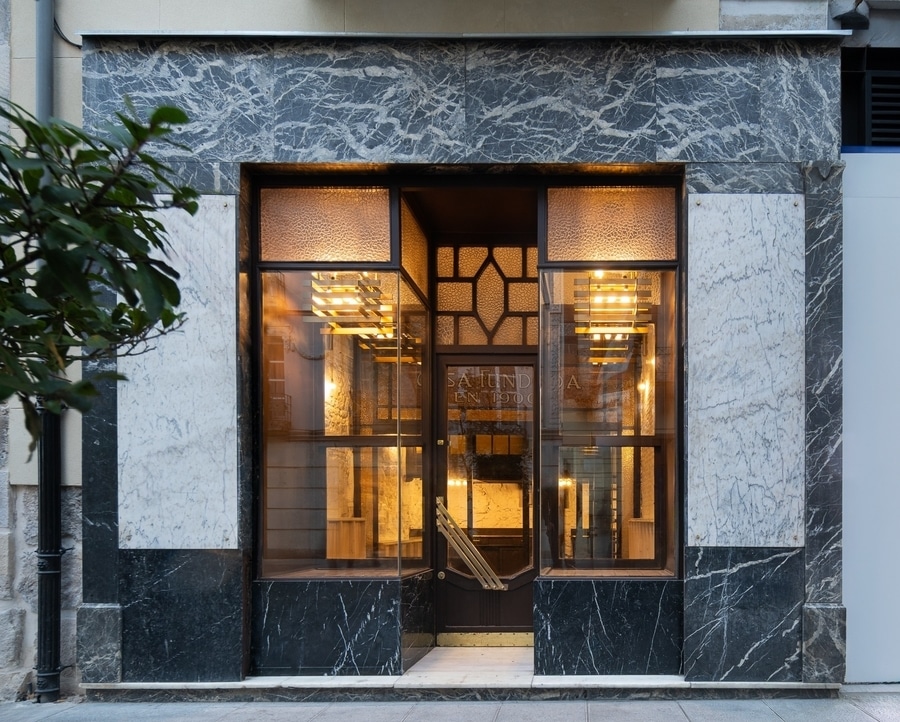
Located on Calle Santiago, the premises were designed in 1934 by architect Ramón Pérez Lozana. The refurbishment prepares them for a new chapter as a jewellery shop, preserving the features that define their character.
The intervention includes the restoration of furniture, glazing, marble and metalwork, while keeping visible the traces of successive changes to the space. The work of the different craftspeople therefore plays an essential role in restoring the whole.
In this context, incorporating contemporary building services required careful integration. Comfort had to support the operation of the premises while coexisting with their materials, furniture and architectural details.
Climate control without an outdoor unit
The premises are served by a Tekno Point IDRA-18 H paired with a DBIS ducted indoor unit.
The solution uses water-cooled condensing technology, eliminating the need for an outdoor condensing unit and air grilles on the façade for heat exchange.
This configuration offers an alternative for projects where installing outdoor equipment is incompatible with the building’s characteristics or the conservation and design objectives. Locating the condensing unit indoors broadens the possibilities for integrating the system.
Integration continues inside
At Cuchillerías Blanco, the DBIS ducted indoor unit is concealed, while the openings required for air circulation are incorporated into the technical timber skirting. Slots formed directly in the finish reduce the visual presence of the installation.
The technical skirting coordinates climate control requirements with the interior design. The solution shows how a construction element can fulfil several functions while contributing to the visual continuity of the space.
IDRA Next and the possibilities of water-cooled condensation
Alongside the architectural feature, Tectónica publishes an article dedicated to IDRA Next, Tekno Point’s water-to-air climate control system with an internally installed condensing unit.
Its Full DC Inverter technology modulates operation according to thermal demand. The option to combine the condensing unit with different types of indoor units makes it possible to develop configurations suited to the characteristics of each project.
For architects, building services designers and installers, this flexibility allows equipment placement, air distribution and spatial integration to be considered together.
Comfort as part of the refurbishment design
The Valladolid reference highlights the importance of considering building services from the earliest design decisions. In historic spaces, the choice of climate control system influences the possibilities for use as well as the preservation of the external appearance and the quality of the interiors.
The refurbishment of Cuchillerías Blanco illustrates this relationship: an integrated technical solution meets the contemporary needs of the premises while allowing the architecture to take centre stage.
Read the full feature on Cuchillerías Blanco in Tectónica
Read the article on IDRA Next in Tectónica
Architectural design: Óscar Miguel Ares Álvarez
Photography: Gabriel Gallegos Alonso
Original feature and interview: Tectónica