
#Industry News
LVE Tactile by Casalgrande Padana: flooring that helps users find their way
Casalgrande Padana presents LVE® Tactile, an innovative wayfinding system featuring porcelain tiles and combining touch and sound.
The system is designed to foster independence and help blind and low-vision users to get around more safely and independently. This is a solution that brings together design, technology and accessibility, turning flooring into an active tool that helps users navigate their surroundings.
Accessibility is acquiring an increasingly important role in contemporary architecture and design. It’s not just about eliminating physical obstacles. It requires a comprehensive rethink of spaces, so that they can be recognised, interpreted and used independently by people with different levels of visual perception. It is with this in mind that we have designed LVE® Tactile, a solution able to develop tactile and vocal paths aimed in particular at blind and partially sighted users. The system combines special porcelain tile trims with magnetic transponders, integrating an authentic tactile and auditory language into the flooring. Surfaces thus become a guide able to accompany the user through the environment, providing indications to help them find their way around buildings and public spaces independently.
Communicative flooring
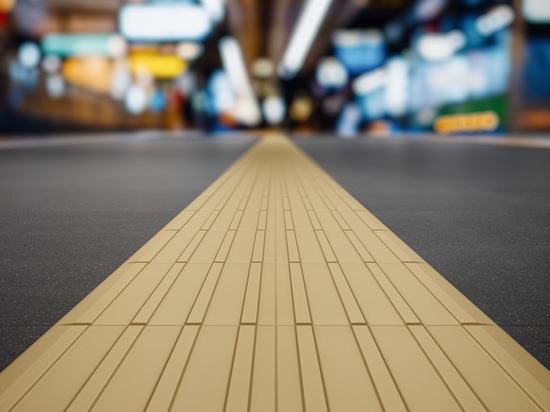
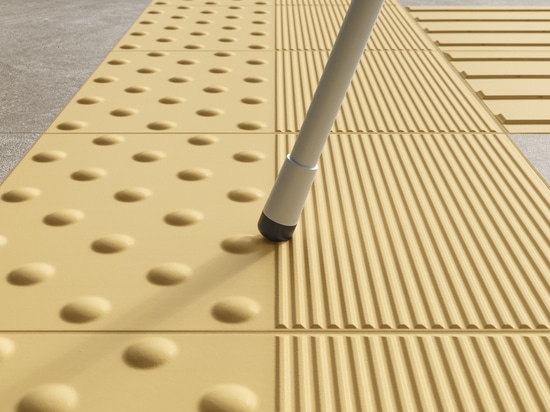
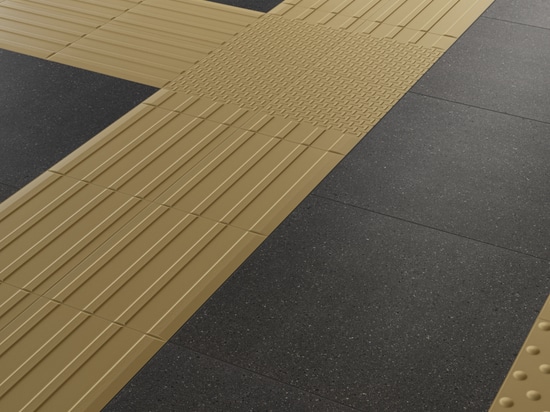
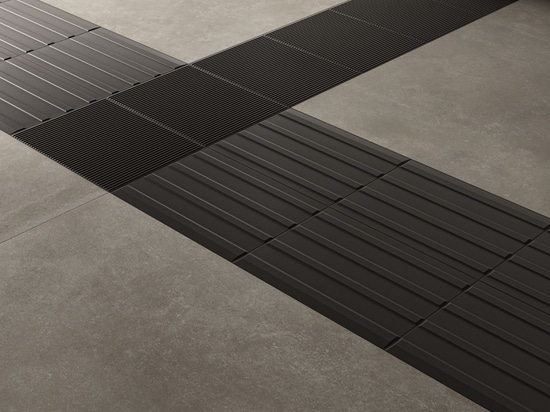
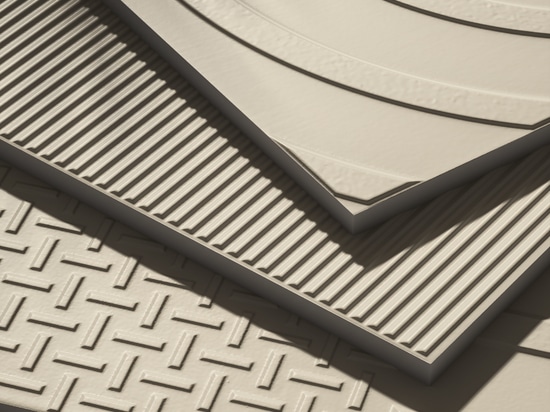
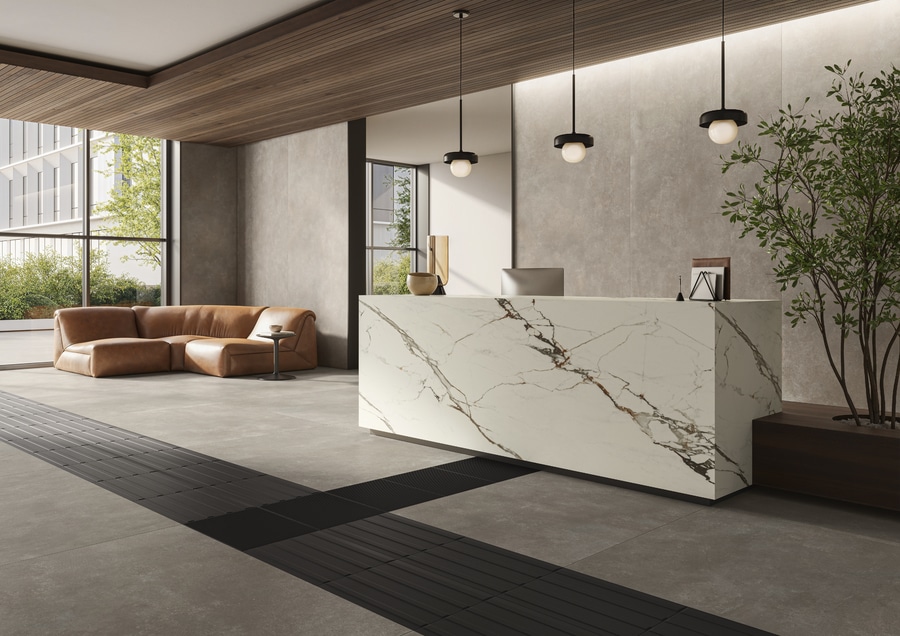
LVE® TACTILE is a wayfinding system of Tactile Ground Surface Indicators (TGSI). This porcelain tile flooring uses tactile codes and guides to indicate straight direction, mandatory 90-degree turn, X or T intersection, attention/service, stop/absolute danger and crossable danger. The shape, spacing, height and groove radius of the raised surface guides use the carefully positioned magnetic transponders to provide prompt, continuous verbal clues to help uses navigate the environment.
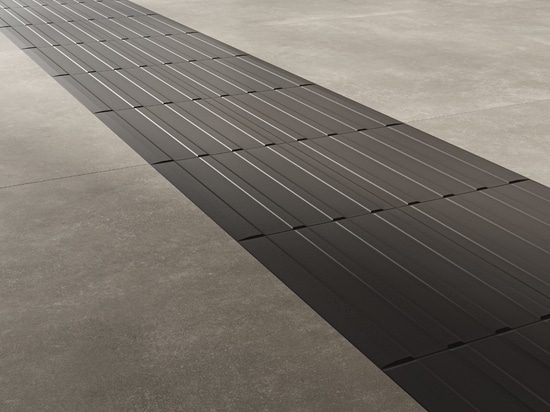
The tactile guides created with the LVE® TACTILE system by Casalgrande Padana use four different sensory channels to provide directions: kinaesthetic and plantar sensation, touch (with the white stick), hearing, and visual contrast (for the partially sighted). What distinguishes LVE® TACTILE from other wayfinding systems for the blind is the introduction of magnetic sensors (TAG-RFG). The antenna built into smart canes is able to detect these sensors when the user walks across the directional tiles. The RFID (Radio-Frequency Identification) based TAG-RFG sensors are positioned under the porcelain tile elements. After on-site mapping, the sensors send a Bluetooth signal to the user’s earpiece or smartphone/tablet, and convert it into directional information (turn right, go straight on) or other indications to help them navigate the environment. The modular elements of the flooring system are available in three thicknesses – 9 mm, 14 mm and 20 mm – in the colours Bianco, Giallo and Antracite, in the size 30x40 cm.
LVE® Tactile reflects an approach to accessibility in which the needs of people with disabilities are considered not as a subsequent addition to a design project, but as an integral part of how spaces are conceived. The result is a multi-sensory wayfinding system, in which architecture and technology work together to make spaces safer and easier to use independently. This is a step forward that views accessibility as an intrinsic feature of contemporary architecture: no longer an add-on, but an actual part of the design project’s identity. This approach is particularly important today. Design is no longer expected to focus simply on aesthetics and performance; it’s called upon to respond to questions regarding the user experience, and how to ensure every individual is able to use spaces with increasing independence and safety.
Casalgrande Padana porcelain stoneware: innovative and sustainable
Here at Casalgrande Padana, developing advanced, eco-friendly ceramic materials is part of our DNA. We aim to strike a sustainable balance between respect for natural resources, environmental protection, technological progress, economic growth and social responsibility. Our ceramic tiles are glaze-free and made exclusively from natural raw materials. In our closed-loop manufacturing process, sophisticated anti-pollution equipment allows all the components to be recycled and reused, reducing emissions and dispersions to almost zero. All the waste water and 99.6% of solid waste is recovered in the production process. Our photovoltaic and co-generation plants produce 86% of the energy we use, and our packaging is 100% sustainable. Ceramic tiles are sturdy, long-lasting, and reliable, making them the perfect choice for sustainable architecture.
Bios Antibacterial® treatment
Ceramic tiles are a top choice in modern building design, thanks to their natural beauty and superb performance. Porcelain stoneware tiles are environmentally sustainable, fully recyclable, fire-resistant and frost-resistant, and offer impressive performance in any climate. They also have excellent bending strength and load resistance, and won’t warp or fade. Ceramic material is naturally non-allergenic and odour-free, because it doesn’t retain dirt and bacteria. In addition, the exclusive, permanent Bios Antibacterial® treatment Casalgrande Padana applies to its tiles eliminates 99.9% of bacteria from the surfaces. Bios Antibacterial® uses a silver ion technology that blocks the metabolism of bacteria, eliminating them and preventing them from spreading. This keeps surfaces safe, beautiful and ideal for all sorts of uses.