#Product Trends
Rented Warehouse, Single-Phase Power: Drying Without a Fixed Installation
Sizing a mobile industrial dehumidifier by moisture load — with flexible-duct air distribution that rolls away when the lease ends.
Some humidity problems cannot be solved with a fixed installation — because the lease forbids it, because the site has no three-phase supply, or because the problem only exists a few months a year. In these cases a mobile industrial dehumidifier is not a fallback but the correct engineering answer. A worked example from a rented site near Amsterdam.
The situation
A rented, unheated brick storage unit of 120 m² (504 m³) near Schiphol airport. Three hard constraints: the lease prohibits permanent installations and wall penetrations; the site has single-phase 220–230 V power only; and staff visit only a few times per week.
The moisture problem is classic for unheated massive buildings: after winter, brick and concrete hold +8…+10 °C for weeks. When warm Atlantic air arrives at +16 °C / 90% RH, its dew point of +14.4 °C sits above the surface temperature — and condensation forms on floors, walls and goods without a single leak.
The numbers
• Background load (+12 °C, 85% RH outdoors): ≈ 10 L/day from infiltration.
• Peak load (+16 °C, 90% RH, gate in use): up to ≈ 95 L/day.
The specification follows directly: effective removal of at least 95 L/day at +15…+16 °C (about 180 L/day rated at 30 °C / 80% RH), airflow of 2–4 air changes per hour, single-phase operation, an active defrost system, remote monitoring — and nothing that has to be built into the building.
The solution
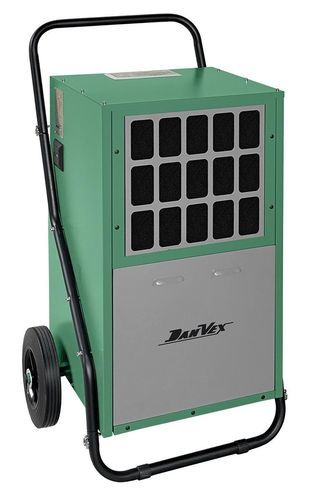
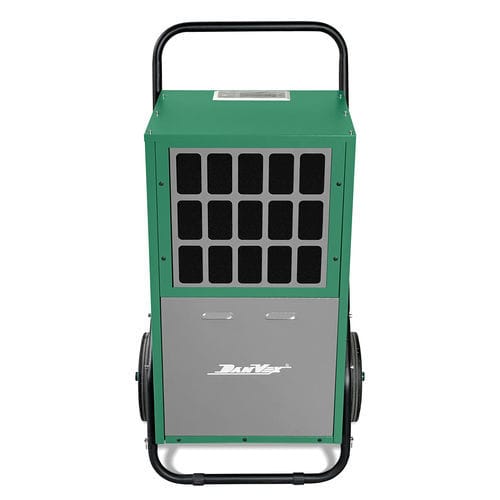
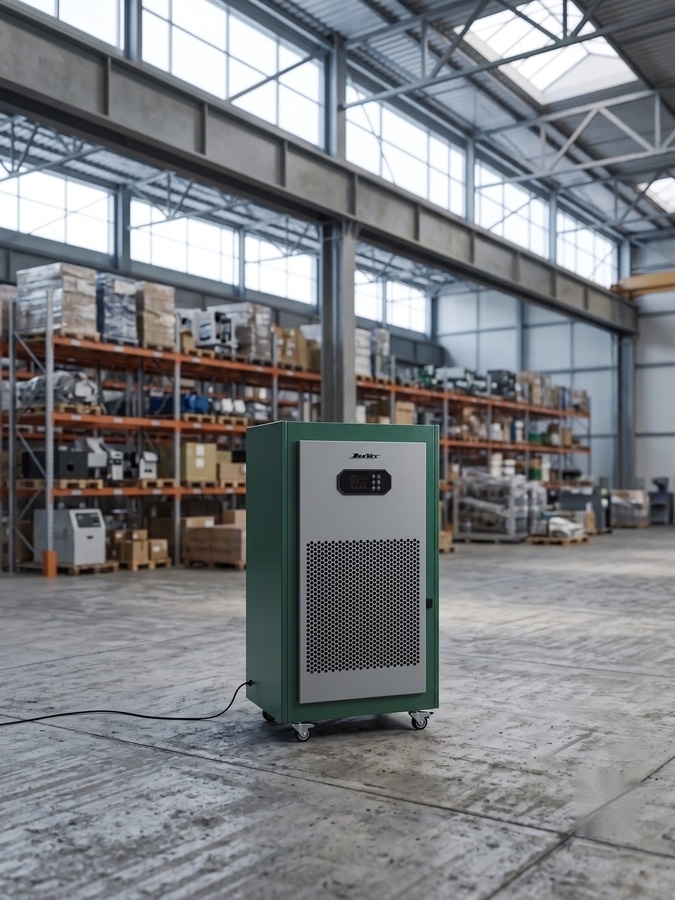
One DanVex DEH-1900i mobile industrial dehumidifier: 180 L/day rated capacity (90–108 L/day effective at these temperatures), 2000 m³/h giving ≈ 4 air changes per hour, single-phase 220–230 V from a standard socket, Hot Gas Defrost for low-temperature duty, direct drain for unattended operation, and Wi-Fi plus Modbus RTU RS-485 on board.
The detail that makes the mobile format work in a 12-metre room: two duct ports accept flexible ducting routed along the cold wall and behind racking — dry air reaches the corners where dew forms first, and the whole setup rolls away without a trace when the lease ends. With remote setpoint access, the operator can also lower target RH preventively before a forecast warm front, so the building enters the critical period already dry.
The takeaway
Mobile when: rented premises, single-phase power only, seasonal or migrating load, capacity within ≈ 180 L/day per unit. Stationary when: humidity control is part of the permanent building specification, three-phase supply is available, or the load calculation demands 200–1000 L/day.