#Industry News
Condensation Without a Leak: Drying an Unheated Brick Warehouse
Why cold brick condenses water from mild spring air — and how to size the dehumidifier by moisture load, not floor area.
Every spring, facility teams operating older warehouse buildings go looking for roof leaks — and in most cases find none. Water on the floor, damp lower walls and mould on stored goods usually have a thermodynamic cause: a cold building mass meeting humid outdoor air.
The mechanism
Through winter, brick walls, a concrete slab on grade and steel racking cool down to roughly +8…+10 °C, and their thermal mass keeps them there for weeks. When a warm Atlantic front arrives at +16 °C and 90% RH, the incoming air carries about 10.2 g of water vapour per kg of dry air — a dew point of +14.4 °C. Every surface colder than that condenses moisture straight out of the air. No leak required.
The case
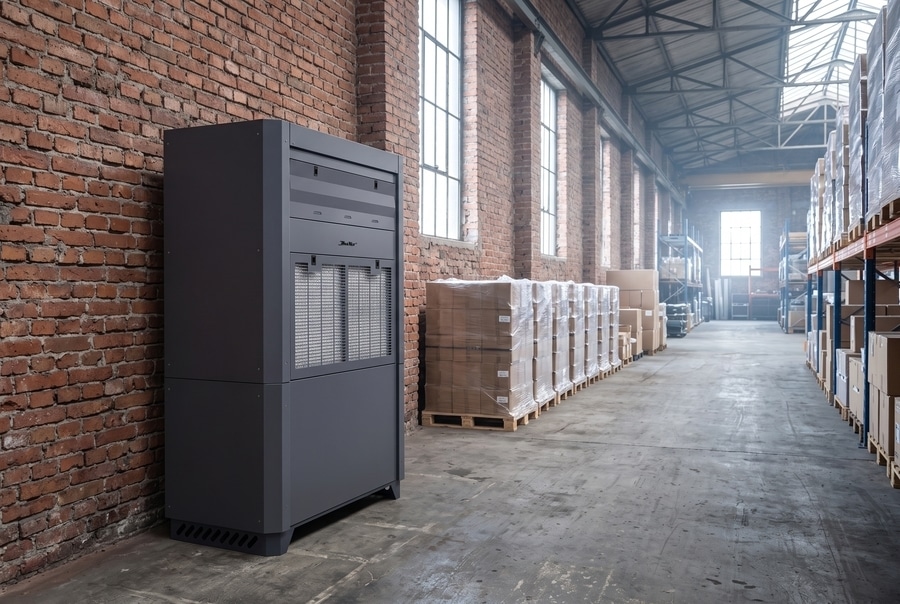
We ran the full moisture-load calculation for a typical site near Amsterdam: an unheated 300 m² brick warehouse (1440 m³), no insulation, metal swing gates without a vestibule.
• Typical mode (+12 °C, 85% RH outdoors): moisture gain ≈ 24 L/day from background infiltration.
• Peak mode (+16 °C, 90% RH, active loading through the gates): moisture gain up to ≈ 275 L/day.
From this load, the equipment specification follows directly: effective removal of at least 275 L/day at +15…+16 °C (about 500 L/day rated at the standard 30 °C / 80% RH test condition), airflow of 2–4 air changes per hour, an active defrost system for continuous duty near +8…+10 °C, efficient part-load operation, and remote humidity monitoring for an unstaffed site.
The solution
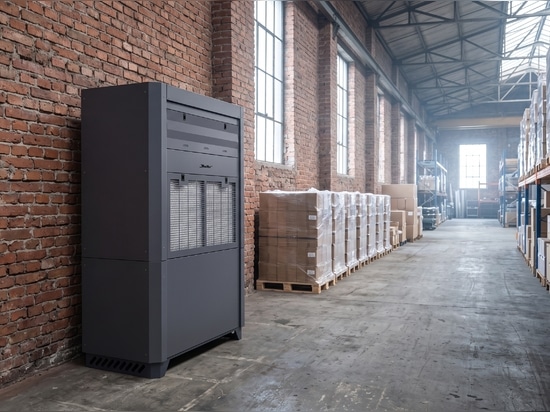
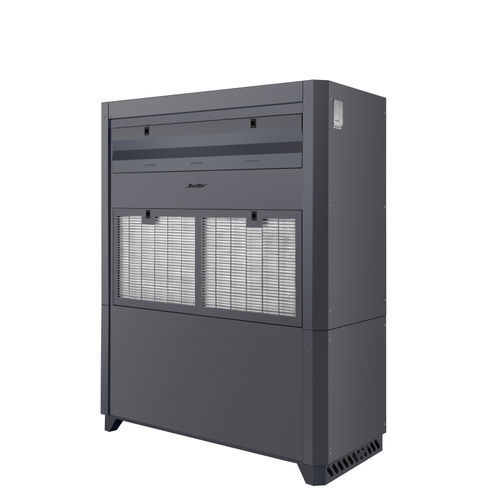
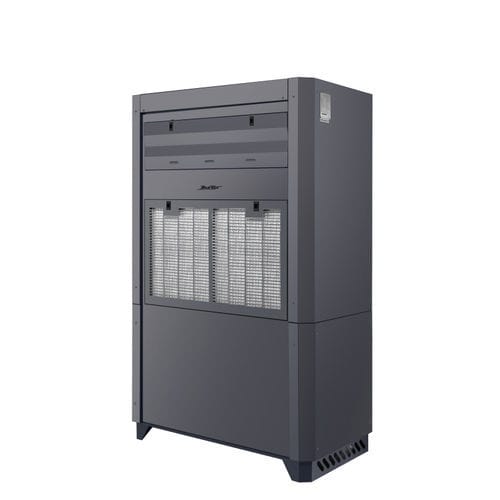
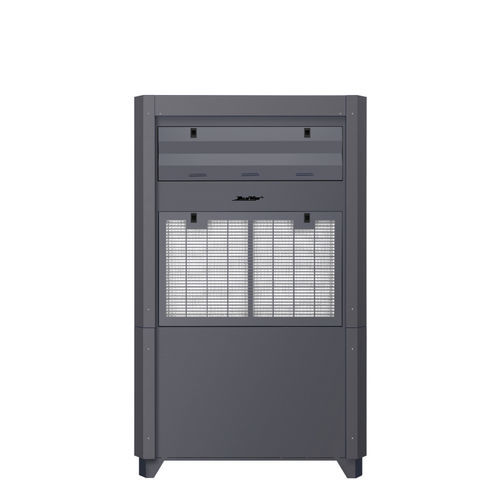
A single DanVex DEH-5K industrial dehumidifier closes the specification: 500 L/day rated capacity (250–300 L/day effective at these temperatures), 4800–5300 m³/h airflow giving 3.3–3.7 air changes per hour, Hot Gas Defrost for low-temperature duty, a Full Inverter drive that modulates down to the ≈ 24 L/day background load instead of cycling at full power, and Wi-Fi plus Modbus RTU for remote monitoring.
The takeaway
Do not size a dehumidifier by square metres. Published coverage figures assume heated, insulated spaces. An unheated brick building with swing gates carries a moisture load several times higher per square metre — selection must follow the calculated moisture balance: infiltration, gate operation, surface temperatures and target RH.