#Industry News
BEYOND FLOORING: DISCOVER PROFESSIONAL RUBBER ROLL SOLUTIONS AT WWW.BEKARUBBERROLL.COM
Discover our rubber rolls for construction purposes
Beyond Flooring: How Recycled Rubber Rolls Are Redefining Modern Construction
Modern architecture is no longer driven exclusively by aesthetics. Today’s buildings are expected to perform. They must absorb vibration, reduce noise transmission, improve user comfort, protect technical systems, increase durability and contribute to increasingly demanding sustainability goals. As construction evolves toward more intelligent and responsible solutions, materials once considered secondary are becoming central elements in the overall performance of a project.
This is precisely where recycled rubber roll technology is beginning to transform the way architects and engineers approach construction systems.
At BEKA RUBBER, recycled rubber is not treated simply as a flooring material. It is approached as a technical solution capable of solving structural, acoustic, protective and mechanical challenges across a wide variety of modern applications. The website was conceived not merely as a catalog of products, but as a platform where professionals can discover new ways of integrating high-performance recycled rubber systems into contemporary architecture and engineering.
For decades, rubber products have been associated primarily with gyms or industrial mats. However, the reality is far broader and far more sophisticated. Recycled rubber rolls are now increasingly integrated into construction systems where vibration dampening, acoustic insulation, impact absorption and structural decoupling are essential. In many projects, these materials remain hidden beneath the final finishes, yet their contribution to the performance and longevity of the building is critical.
The growing complexity of modern structures has created new demands. Lightweight construction systems, floating floors, rooftop installations, technical rooms, data centers, modular buildings and mixed-use developments all require materials capable of mitigating mechanical stress and acoustic transfer while maintaining long-term stability. Traditional rigid construction solutions often struggle to absorb movement, vibration and impact energy. Recycled rubber, by contrast, introduces elasticity into the system.
This elasticity becomes particularly valuable in urban architecture, where buildings are increasingly exposed to vibration from traffic, mechanical systems, elevators, HVAC equipment and human activity. In such environments, acoustic comfort is no longer considered a luxury but a technical requirement. Architects and engineers are therefore searching for materials that can reduce structure-borne noise without complicating the construction process or significantly increasing project costs.
One of the most interesting aspects of recycled rubber rolls is their versatility. The same material technology can perform completely different functions depending on density, thickness and application method. In one project, it may function as an acoustic underlayment beneath floating flooring systems. In another, it may serve as a protective separation layer between waterproofing membranes and rooftop mechanical installations. In industrial or technical environments, it may isolate vibration beneath machinery or protect delicate substrates from concentrated loads.
This multifunctionality is one of the reasons why recycled rubber solutions are increasingly specified by forward-thinking engineering firms and architects looking for integrated performance-based materials.
The philosophy behind BEKA RUBBER reflects this technical approach. Rather than offering generic rubber products, the website organizes solutions according to real-world construction challenges. Each product category has been developed to address a specific technical need, whether related to acoustic insulation, vibration absorption, structural protection or mechanical durability.
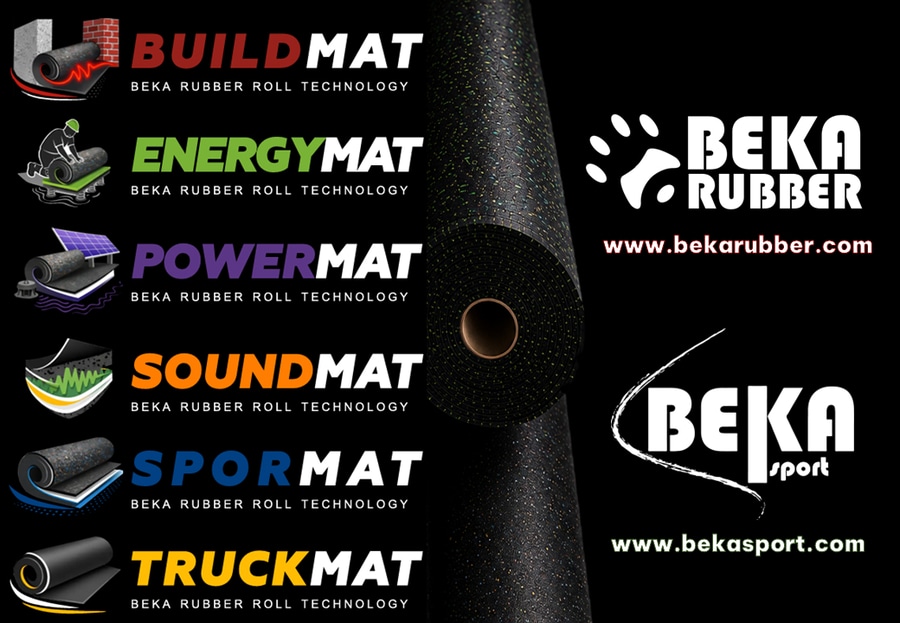
Solutions such as BUILDMAT focus on improving acoustic and vibration performance inside walls, floors and structural assemblies. SOUNDMAT systems are designed for projects where airborne and impact sound insulation are priorities. POWERMAT products address the growing demand for rooftop protection and vibration-resistant support layers beneath solar panels, walkways and technical installations. SPORMAT systems are engineered as elastic underlayments for sports surfaces, while TRUCKMAT solutions respond to demanding cargo and transportation environments where anti-slip resistance and durability are essential.
What makes these systems particularly attractive to design professionals is that they operate quietly in the background of a project while significantly improving the behavior of the overall construction system.
At the same time, sustainability considerations are reshaping material selection across the industry. Architects and developers increasingly seek products that contribute to circular economy principles and environmental certifications. Recycled rubber technology aligns naturally with these objectives by transforming post-consumer and industrial rubber waste into long-lasting technical materials with measurable performance characteristics.
This combination of sustainability and functionality is especially relevant in sectors such as data centers, logistics facilities, educational buildings, sports infrastructure and commercial developments. In many of these projects, technical performance and environmental responsibility are no longer separate discussions. They are part of the same specification process.
Another important advantage of recycled rubber systems lies in their simplicity of integration. Unlike highly complex engineered assemblies requiring specialized installation procedures, rubber roll solutions can often be adapted easily within existing construction methodologies. This allows architects and engineers to enhance the performance of a project without radically altering the construction process itself.
Yet perhaps the most intriguing aspect of recycled rubber technology is that its potential remains largely underestimated. Many professionals still associate these materials only with visible flooring applications, while some of the most valuable uses actually occur beneath the surface: inside floating floor systems, under technical equipment, beneath membranes, inside wall assemblies or within vibration-sensitive installations.
As buildings become increasingly technical and performance-oriented, these hidden layers gain strategic importance.
At BEKA RUBBER, the objective is not simply to sell recycled rubber products, but to help professionals rethink how flexible technical materials can improve modern construction systems. The website has been designed as a source of inspiration for architects, engineers, contractors and developers seeking solutions capable of combining durability, technical performance and environmental responsibility.
The future of construction will not depend exclusively on stronger materials, but on smarter systems capable of absorbing stress rather than merely resisting it. In this context, recycled rubber rolls represent far more than a secondary building component. They become part of a broader architectural and engineering philosophy focused on comfort, resilience, sustainability and long-term performance.
Sometimes, the most important materials in a building are the ones people never see.
And increasingly, recycled rubber is becoming one of them. Discover our solutions here: www.bekarubberroll.com