#Industry News
Is recycled rubber flooring waterproof?
What to know about recycled rubber flooring if contact with water and moisture
Walk into a commercial gym after eleven in the evening and you'll quickly discover whether a flooring system can handle real-world conditions. Sweat, cleaning water, spilled drinks, moisture tracked in from outside, and constant equipment movement all put flooring to the test.
One of the most common questions facility owners ask is simple:
Is recycled rubber flooring waterproof? Well, the answer is not as straightforward as many people think.
Unlike homogeneous rubber flooring, recycled rubber flooring is manufactured from compressed rubber granules bonded together with polyurethane binders. This structure gives the material exceptional durability, impact absorption, slip resistance, and acoustic performance. However, it also means recycled rubber behaves differently when exposed to moisture.
In most commercial applications, recycled rubber flooring performs extremely well around water. But understanding how moisture interacts with a granulated surface is essential when selecting the right flooring system.
Understanding How Recycled Rubber Flooring Handles Water
Many people assume that all rubber flooring is completely waterproof. In reality, there is an important difference between:
* Waterproof materials
* Water-resistant flooring
* Moisture-resistant flooring systems
Recycled rubber flooring falls primarily into the second category.
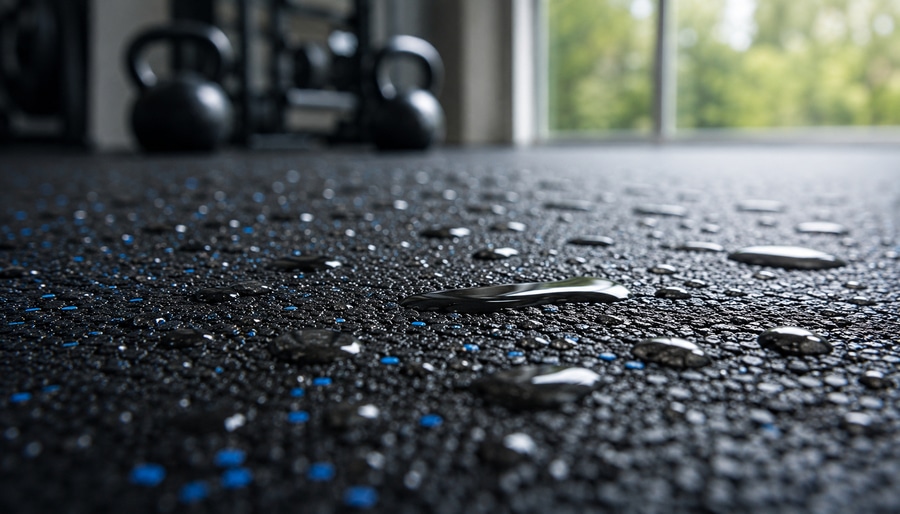
The rubber granules themselves do not absorb significant amounts of water. However, since the surface is composed of thousands of bonded particles, microscopic spaces remain between the granules. These small voids can allow limited moisture penetration depending on the density of the product and the duration of water exposure.
This fact does not mean water will damage the flooring. In fact, high-quality recycled rubber flooring is specifically designed to withstand frequent cleaning, sweat, and everyday moisture without deterioration.
The key difference is that water may slowly migrate through the granulated structure if standing water remains on the surface for extended periods.
Density Matters More Than Most Buyers Realize
Not all recycled rubber flooring performs the same way. A high-density recycled rubber roll manufactured with fine granules and controlled binder content behaves very differently from a low-density tile made with larger particles.
Generally speaking:
High-density rubber rolls offer better resistance to moisture penetration, have fewer seams and are easier to clean. Plus, the rolls offer improved dimensional stability and in general they offer better long-term performance in commercial gyms
High density recycled rubber tiles, on the other hand, present excellent durability and are much easier to replace in case of a faulty tile. Installation is faster but there are more joints where moisture can travel.
On the contary, Low-density products show higher porosity, greater moisture transmission and they are more suitable for drainage applications than moisture sealing.
For facilities where water resistance is important, density often becomes a more critical specification than thickness alone.
The Advantage of a Granulated Surface
Interestingly, what some buyers see as a disadvantage can actually become a benefit.
Because recycled rubber flooring is not completely impermeable, it allows a certain degree of moisture vapor transmission. This can reduce the risk of trapped moisture beneath the floor compared with completely sealed surfaces.
In sports facilities, fitness centers, and weight rooms, this characteristic often contributes to better long-term performance, particularly when concrete substrates contain residual moisture.
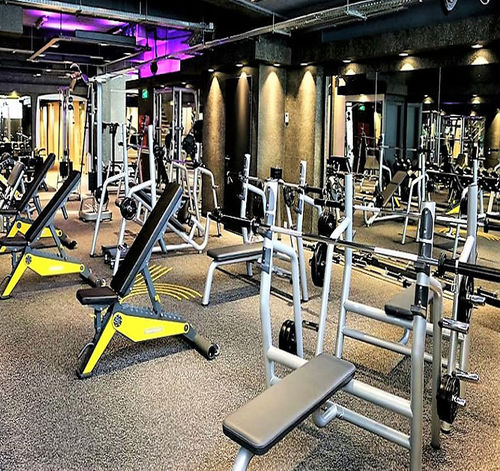
For this exact reason, recycled rubber flooring is frequently selected for commercial gyms, Functional fitness facilities, Cross-training areas, Free-weight zones, Indoor sports facilities, Ice rink walkways, Ski resort gyms and Multi-purpose training centers.
Is Recycled Rubber Flooring Suitable for Wet Areas?
The answer depends totally on the amount of water involved. Recycled rubber flooring performs exceptionally well in areas exposed to sweat, water bottles, routine mopping, damp cleaning procedures, rainwater tracked indoors, seasonal snow and moisture. These conditions, as you can imagine, represent the vast majority of gym and sports flooring environments.
In these environments, flooring selection should be based on the complete flooring system rather than the rubber surface alone.
However, there are certain areas requiring special consideration and for sure they need additional waterproofing measures: shower rooms, pool surrounds, hydrotherapy areas, spaces with continuous standing water, etc.
Where Moisture Problems Usually Begin
When recycled rubber flooring experiences moisture-related issues, the flooring material itself is rarely the cause. Most problems originate from a poor subfloor preparation, excessive moisture in concrete slabs or improper adhesive selection. It is also noticeable in case there are open seams between rolls or wrongly fitted tile joints.
Keep in mind something crucial: even the highest-quality flooring can underperform if installation practices are not followed correctly.
This is why professional installers always recommend testing substrate moisture before installation and selecting adhesives compatible with the specific flooring system.
Recycled Rubber Rolls vs Tiles: Which Performs Better?
When moisture resistance is a priority, recycled rubber rolls generally offer the best performance. The reason is simple: adhesive is used in order to create a bond between the substrate and the rolls and there are fewer seams.
A recycled rubber roll can easily cover several square meters without interruption, reducing the number of locations where water can potentially migrate below the surface.
Rubber tiles, on the other hand, provide greater flexibility and easier replacement, but they naturally introduce more joints into the installation.
Neither solution is inherently better. The correct choice depends on the facility's operational requirements, maintenance procedures, and moisture exposure levels.
The Real Pros and Cons of Granulated Rubber Flooring
Let´s focus on water and moisture pros and cons:
✓ Excellent resistance to everyday moisture
✓ High slip resistance, even when slightly damp
✓ Can help manage moisture vapor transmission
✓ Long service life with minimal maintenance
Limitations
✓ Not a fully waterproof membrane
✓ Extended standing water may slowly penetrate through the granulated structure
✓ Tile systems contain more potential moisture pathways than rolls
✓ Performance varies significantly depending on density and manufacturing quality
✓ Wet-area installations may require additional waterproofing measures
So, Is Recycled Rubber Flooring Waterproof?
The most accurate answer is:
Recycled rubber flooring is highly water-resistant but not completely waterproof in the same way as a continuous waterproof membrane.
For commercial gyms, fitness centers, sports facilities, and most indoor applications, high-quality recycled rubber flooring provides more than enough protection against everyday moisture exposure.
The key is understanding that performance depends on the complete flooring system—product density, surface structure, seam treatment, installation quality, and subfloor conditions—not simply on the fact that the material contains rubber.
When specified correctly, recycled rubber flooring remains one of the most durable, practical, and moisture-resistant flooring solutions available for modern sports and fitness environments.